“We need AI in our support function!”
As a CTO, you must have heard this phrase in a number of situations in the past two years with stakeholders. What many AI enthusiasts don’t know is that we can’t simply entrust all our responsibilities to the chatbot and leave it at that. The ones who become frustrated are typically the customers who slipped through the cracks between an AI that was not able to resolve their issue, and a human that did not receive the handoff.
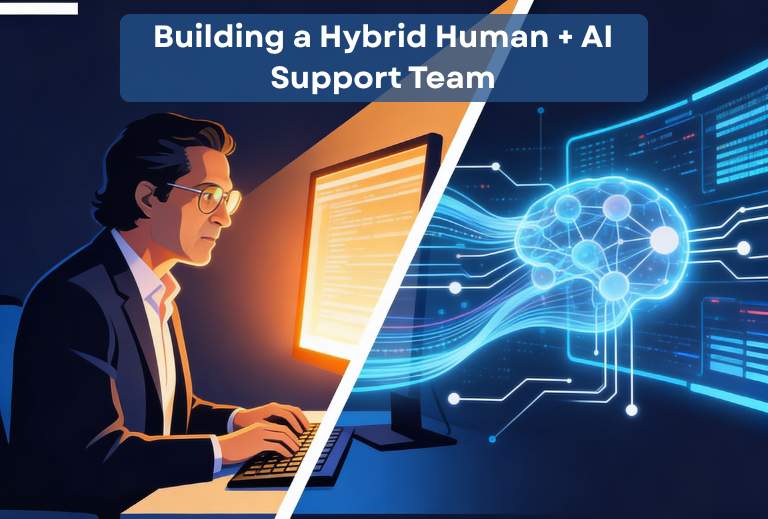
The question is not so much ‘should you use AI for support’ as ‘how should you do it’. It’s about how to get humans and AI to collaborate.
There’s some real academic research in here, and it’s more useful than the vendor decks. Research into hybrid intelligence systems, human-AI team design and control arbitration is beginning to merge into a set of principles that can be directly applied to your support operation. This guide makes that research into something practical.
Start Thinking About AI As A Team Member
The most common error with hybrid AI support models is to view AI as an infrastructural element instead of a tool with a specific purpose. If you think of it as plumbing, then you’re left with a system in which no one is really thinking about what AI should be doing, when it should be doing it, and when it should not be doing it.
It causes confusion with customers and among human agents performing the task.
Thus, the study of hybrid intelligence systems poses the problem in a different context. Don’t ask your human agents how AI can help them. Now it is important to question who does what, and who takes authority from whom? Because that is an entirely different situation then. This is a whole other design question and you get better results.
It’s like an airplane cockpit. The autopilot is not a tool used by the pilot every once in a while. It is known to have authority under specific circumstances, and there is a clear process for the pilot to take control and the autopilot to take control. Your support operation needs the same kind of architecture. AI handles what it handles well, humans take over when conditions demand it, and the transitions are deliberate rather than accidental.
The Hierarchy Problem: Where Do You Place AI In The Team?
One of the most interesting results of the recent research, which focused on the collaboration between humans and AI, is what happens if you switch the position of the AI, not its ability. A study of hybrid team dynamics revealed that the same AI system with the same level of intelligence exhibited dramatically different human behaviour when it was positioned as a superior, as a peer and as a subordinate.
The counterintuitive result was this: the more that human agents liked and trusted the AI, the more it created conflict for them, not less. The explanation is based on identity. Cooperation with an AI colleague is a form of cooperation with a being without the social reciprocity and the shared experience that peer relationships typically require, and without empathy. That is where friction sets in, even when the AI is doing well.
The best success had been when they used AI as a second-hand man: a powerful tool that humans control and override. With this setup, the more intelligent the AI, the more agents are relied upon, and the more successful they become, with virtually no rise in conflicts. This is the default configuration you’ll use if you’re making most CTO-level decisions about your support team structure. Allow your human agents to feel like they run the show and that’s exactly what will happen, according to research.
Transparency Is The Foundation Of Hybrid Teams
Transparency is always at the top of the list of dimensions that can make or break a hybrid support team. Not transparency as in PR, but operational transparency: Each team member (human or AI) should understand what each other does, the strengths and weaknesses of each team member, and the decision-making process.
In reality, this implies your human assistance agents have to know what your AI can and can’t do. Not in vague terms. They must understand the circumstances in which the AI is likely to fail, the sorts of queries it can confidently answer, and how the confidence level of the AI in the answers it gives relates to their accuracy. If that’s the case, agents can’t make smart choices regarding when to go with the AI suggestion and when to overrule it.
There is something important that has been discovered through research on explainable AI in human-AI collaboration. We are not very good at estimating the accuracy of our guesstimate, nor are we very good at assessing the accuracy of the AI without explicit instructions. Under conditions that it isn’t very trustworthy, agents will tend to be more trusting, and under conditions that it is very trustworthy, agents will tend to be less trusting. This is something that will have to be addressed by your system design, not assumed by agents.
How To Think About Automation Bias In Your Support Team
So what exactly is ‘Automation bias’? One of the most hazardous risks for any hybrid AI support model. When human agents become complacent with the AI recommendations and rely on them as the standard answer. Sound familiar? We know how AI models can be used by millions of people to have questions answered that they would have gone to Google about before. Although the small print at the bottom states “fact check,” they believe that AI can provide them with accurate and precise answers. In CX this can also be seen. The AI responds for the agent that the refund is not eligible, and the agent then passes this information on to the customer without verifying. The AI gives neutral sentiment for the very frustrated customer, which means the agent does not escalate it.
The first concrete design principle identified in the research is to allow agents to make their own evaluation prior to viewing the AI recommendation: In the studies where the participants predicted the outcome of the AI before it was shown, the performance of the teams was significantly better.
The sequence matters. If agents see the AI output first, they latch onto it. If they reason first, they engage more critically and catch more errors.
This has interface consequences. Is the AI-recommended response at the top of your support platform the default that is visible? If so, you’re likely to be training your agents into automation bias without realizing it. Think about whether the design might encourage the agent to categorize the type of query or determine its urgency before making the AI recommendation.
The Control Handoff: Building A Dynamic Delegation System
In the ideal scenario of hybrid support teams, the AI does not manage a specific type of tickets, and humans do not handle the other specific type of tickets. Control is dynamic and adapts to the conversation situation. It’s not as complicated as most support software is built today, but the concepts could be applied to surgical robotics.
Learning from research about control arbitration in hybrid teams, it is clear that the handoff system must only make decisions at intervention points, not continuously. Generally, the person in charge should be left alone to do his job. The system monitors for certain constraint violations such as a conversation that has reached a sentiment threshold, a query type that is not part of the AI’s training distribution, and a customer that has been re-routed multiple times. The handoff logic comes into play when the constraint is violated.
One of the key things you will do when developing your hybrid support model is defining those constraints. Have the following pertinent questions to ask:
- What are some failure conditions for which human take-over is warranted?
- How much confidence in AI is too little to pass to the AI system?
There are no universal answers to these questions, they’re more of a ‘how do you do it’ variety. They depend on a company’s:
- Customers
- Product
- Risk tolerance.
But you need outright answers, not spend an eternity finding them.
What is Complementarity?
There is no such thing as hybrid teams being better overall than pure AI or pure human teams simply because you transmit slightly better results overall.The power of hybrid teams comes not because you get slightly better results everywhere, but because you get results in some areas from humans and in some areas from AI which are superior. That’s because you can expect a ton better performance in situations where one agent type would have done poorly. This complementary team performance is what researchers have called. This is what you are really looking to optimize for.
AI works well on pattern matching, high volume queries, applying policy, and structured data. People are great with emotional intelligence, new circumstances, guesswork, and handling the type of multi-issue complaints that don’t always fall into a definitive category. The difference in performance becomes stark when you structure your support processes to harness that complementarity, instead of relying on an AI agent as a replacement for a human.
It’s a very practical point: Hybrid teams tend to benefit most from situations where the task isn’t covered by the training data, such as when it’s the out of distribution scenario, the ticket that’s completely different from what they’ve seen. These are precisely the situations in which AI is most probable to fail on its own. You can’t just build your escalation logic based on sentiment or topic; it’s a worthwhile investment to be sensitive to distributional novelty instead.
A Practical Framework For Building Your Hybrid Support Team
First, make sure you clarify who your agents are and what they do. Who are these human agents and what are their strengths and what kind of interactions should they have? What is the AI system good at and where is it inaccurate? Write this down. It’s a fundamental thing, but most teams don’t do it and then they operate with ambiguity.
Then establish your rules or conditions (also known as constraints) that should initiate a handoff. Consider safety constraints (when a customer is distressed), performance constraints (when the AI’s confidence is under a set threshold), and critical failure conditions (when a customer has already escalated once and is distressed). Be specific. Ambiguous constraints result in inconsistent hand-offs.
Then create your communication loops. Feedback must be ongoing and transparent, and should be two-way. Human workers should be able to quickly identify AI mistakes, and this input should be fed into the teams responsible for fixing the AI. However, AI systems must convey their uncertainty in a manner that the agents can understand and respond to. The vast majority of the hybrid systems that fall short, are the ones that lack a well-designed communication infrastructure.
Last but not least, train your “human” employees to work in the hybrid environment. Not only on how to work with the tools, but on how to think of the AI as a partner with some defined capabilities and defined limitations. Agents who grasp the inner workings of the AI, not just as a black box and a source of occasional misinformation, can work much better with it.
The Future Is Team Design, Not Model Capability
That’s roughly the consensus of the research: In most human-AI support systems, it is not the intelligence of the AI that is the limiting factor. It is the quality of the team design that is the thing. Companies that approach hybrid support not as a technology purchase, but as a design challenge continually outperform those that don’t.
The role of the CTO is not only to assess LLM vendors or select the suitable automation platform. There is a need to think carefully about roles, authority, transparency, communication and in practice what a good handoff would look like. One support team augmented by AI that actually works is one in which each member of the team knows exactly what they are supposed to do, and who’s leading the charge at any given time.
Build the team first. The technology will follow.