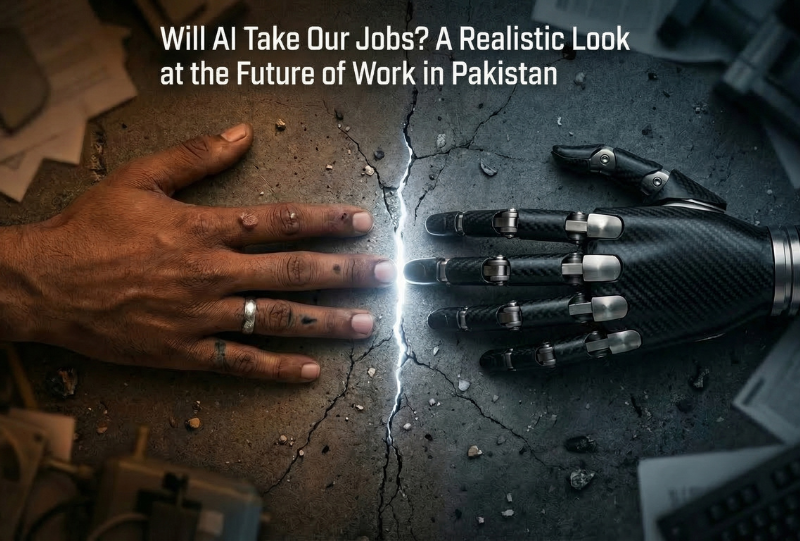
Gen-Z loves to joke about AI takeovers in their memes and content but this is a very real question that hangs over every office, factory floor, and call centre across Pakistan (and the world too!).
Is AI actually replacing jobs?
Pakistan is a nation of 220 million people, where 72.5% of the workforce operates in the informal sector and unemployment has climbed from 4.7 million in 2018–19 to 7.18 million by 2022–23. The threat of AI is not an abstract philosophical debate. It is an urgent, economic reality and the answer is complicated.
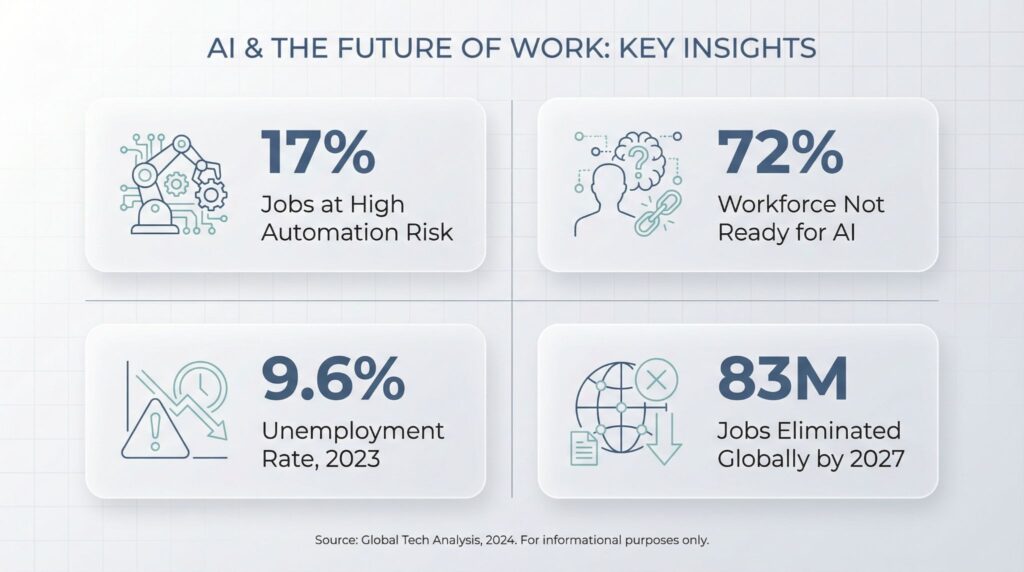
Globally, the World Economic Forum projects that by 2027, approximately 23% of all jobs will undergo significant transformation. The numbers tell a starkly asymmetric story: automation is expected to create roughly 69 million new roles, while eliminating 83 million. That is a net loss of 14 million jobs worldwide and developing economies like Pakistan, with weaker technological infrastructure and a lower-skilled workforce, stand most exposed to the AI job displacement wave.
Which Jobs Will Be Replaced by AI?
Understanding what types of jobs will AI affect the most requires moving beyond industry labels and looking at the nature of tasks themselves. Artificial intelligence excels at work that is repetitive, rule-based, and predictable with remarkable speed and at a fraction of the cost. Wherever a job involves routine task automation, AI is already waiting in the wings.
In Pakistan’s context, the most vulnerable categories are stark and familiar. Data entry and administrative roles — the backbone of countless offices — are being dismantled by AI tools that can extract, verify, and process information in seconds. Manufacturing and assembly-line workers, particularly in Pakistan’s critical textile sector, face displacement from robotics and smart machinery. Think of the time when weaving looms were first introduced. That one invention alone displaced hundreds of thousands of workers. As AI replaces programming jobs in quality control and production planning, even mid-level technical workers are not immune.
The call centre industry illustrates this change perfectly. Chatbots and AI-powered virtual assistants can now handle FAQs, process orders, and troubleshoot basic problems around the clock. This is threatening to hollow out the customer support sector that employs hundreds of thousands of Pakistanis. Research finds that AI adoption in customer service jumped from a mere 5% in 2018 to 70% by 2024, eliminating an estimated 150,000 jobs in the process. An analysis of the research findings on AI and Employment in Pakistan in 2024 indicated that AI is not coming for your industry. It is coming for your tasks. And in Pakistan, where so many livelihoods rest on predictable, low-complexity work, that distinction carries enormous weight.
Mid-level analytical roles like report generation, basic financial analysis, inventory forecasting etc. are equally at risk. AI is replacing programming jobs that once required human judgment by processing data faster, cheaper, and with greater consistency. The concern is not just a hypothesis or dystopian sci-fi movie plot. It is already underway in the Pakistani banking sector, where AI adoption has climbed from 10% to 70% in six years, costing an estimated 150,000 clerical positions.
AI Job Displacement in Pakistan: Sector by Sector
Pakistan’s Labor market structure increases its vulnerability. With heavy dependence on agriculture, low-skill manufacturing, and retail services, the exposure is deep and wide. Especially since approximately 42% of the workforce are employed in occupations rated highly susceptible to automation.
| SECTOR | AI ADOPTION 2018–24 | JOBS IMPACT | RISK LEVEL |
| Manufacturing | From 5% to 50% | 250,000 (−25%) | HIGH RISK |
| Banking & Finance | From 10% to 70% | 150,000 (−30%) | HIGH RISK |
| Customer Service | From 5% to 70% | 150,000 (−21%) | HIGH RISK |
| IT & Software | From 20% to 85% | +200,000 created | GROWTH |
| Healthcare (AI) | From 10% to 70% | +200,000 created | GROWTH |
Agricultural employment, which still accounts for over 37% of Pakistani jobs, faces mechanization and smart-farming technologies. While AI will not upend farming overnight, it is steadily eroding the demand for low-skill rural Labor. Urban retail and services face similar pressure from e-commerce algorithms and AI-driven logistics.
What Jobs Will AI Replace by 2030?
Looking further ahead, global forecasts suggest that by 2030, approximately 37.9 million jobs could be displaced by automation worldwide, with developing countries bearing a disproportionate share. Jobs at over 95% risk of automation include cashiers, data-entry clerks, telemarketers, bookkeeping staff, basic machine operators, and receptionists, occupations that collectively employ millions of Pakistanis.
The phenomenon of Labor market polarisation is already visible. High-skill, high-wage jobs are growing. Low-skill, low-wage jobs in the informal economy persist. But the middle — the clerical supervisors, mid-level analysts, routine customer-facing roles — is being systematically hollowed out. Pakistan’s informal sector, with no job security and no social protection, is especially easy to automate and especially hard to protect.
AI does not replace jobs uniformly. It replaces tasks, and when enough tasks within a job are automated, that job disappears. The real danger lies in the gap between displaced workers and the skills required for the jobs that remain.
The Other Side: AI and Job Creation
Yet the full picture demands honesty about opportunity too. History offers a consistent pattern: every major technological revolution brought short-term disruption and long-term job creation. AI replacing programming jobs in one domain is simultaneously creating an explosion of roles in AI development, prompt engineering, data science, cybersecurity, cloud computing, and robotics.
Pakistan is not without assets here. The country already possesses a vibrant freelance ecosystem. With AI tools lowering the barrier to entry for digital services, Pakistani freelancers experienced a 60% surge in remote work opportunities. AI startups grew by 35% in recent years. Data annotation and AI model training, roles well-suited to Pakistan’s large, multilingual workforce, represent a scalable entry point into the digital economy. The rise of Human-AI Hybrid Teams is perhaps the most important shift to understand.
AI does not replace doctors. It gives them diagnostic tools.
It does not replace farmers. It gives them soil analysis and weather prediction that improves yields.
It does not replace software developers. It gives them AI co-pilots that accelerate output.
The question is not whether AI will take jobs, but whether Pakistani workers will be equipped to work alongside AI rather than be displaced by it.
The Wage Divide: Who Gains, Who Loses
The economic consequences of AI are not distributed equally. Pakistan’s gender wage gap already stands at 34%. This is well above the global average of 23%. AI risk intensifies this divide. Women are disproportionately concentrated in the informal sector and in manufacturing (64% of workers), making them more vulnerable to AI job displacement. Female Labor force participation is already declining as male participation rises, and AI bias in hiring tools risks entrenching these disparities further.
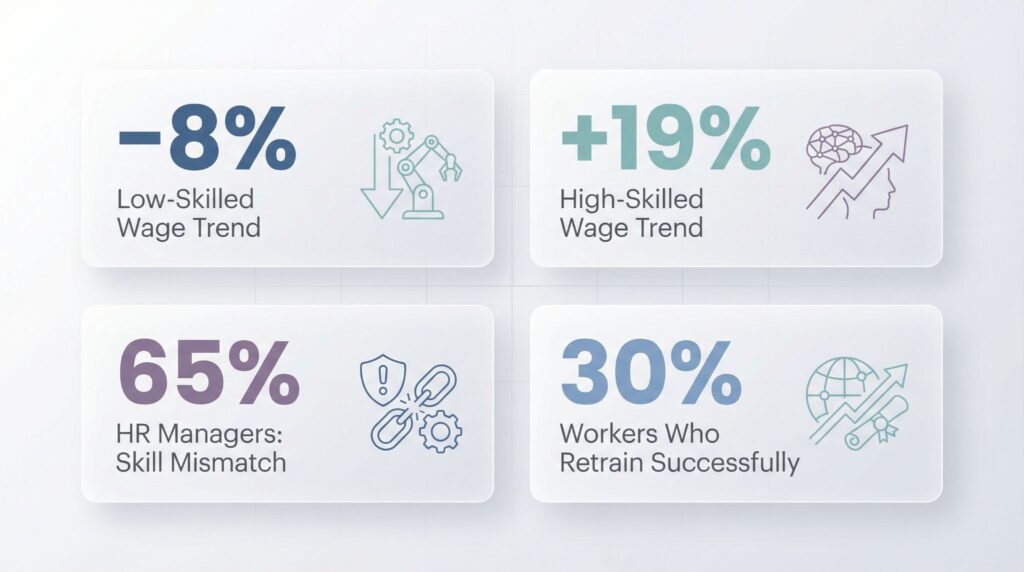
Wage data tells a troubling story: low-skilled wages have fallen by 5–8% as automation pressure intensifies, while high-skilled workers command wages up to 19% higher. In extreme cases, wage devaluation reaches 70% for those whose occupations are most heavily automated. The beneficiaries of AI are primarily capital owners and firms, not the workers whose Labor is being substituted.
The Skills Pakistan Urgently Needs
Only 15% of Pakistani universities currently offer any AI education. Just 30% of displaced workers successfully transition to new roles. The skills gap is the central crisis, and closing it requires a fundamental rethinking of how Pakistan educates and trains its workforce.
Not everyone needs to become an AI engineer. But everyone needs to be able to work with AI. The essential skill categories fall into three pillars: digital fluency (using AI tools, navigating digital platforms), technical skills (data analytics, coding basics, cloud systems), and crucially, human skills that AI cannot replicate e.g. critical thinking, creativity, emotional intelligence, and adaptability. The question of whether AI will take over sales jobs, for instance, is best answered by noting that while AI excels at routine outreach and data-driven targeting, the relational and persuasive dimensions of high-value sales remain deeply human.
Quick Answers: Pakistan & AI in Focus
Will AI replace freelance developers in Pakistan by 2027?
Unlikely in full. AI handles boilerplate code and bug detection, squeezing commodity coders, but freelancers who offer prompt engineering, AI integration, and client strategy will find demand rising.
Impact of AI on entry-level IT jobs in Lahore & Karachi software houses?
Significant and already underway. Junior development, QA, and data entry roles are shrinking, but the same firms are hiring for AI-adjacent work, model fine-tuning, data labelling, and product management. This creates a two-tier market where the skilled gain and the unskilled stagnate.
Reskilling programs for displaced BPO workers in Karachi?
Critically needed but underfunded. Karachi’s BPO sector faces direct pressure from AI chatbots and voice agents. NAVTTC and PIAIC offer pathways, but coverage is thin, and reskilling must target communication-skilled workers for AI training and content moderation roles where their strengths transfer.
Is the National AI Policy creating more jobs than it automates?
Not yet. The policy identifies AI as a job-creation engine, but without a binding employment strategy and scaled workforce development, its benefits remain concentrated among the already-skilled while automation impacts fall broadly on low-skilled workers.
The ‘Hybrid Skill Premium’ for Pakistani tech professionals?
Real and growing. Professionals who pair technical skills with human judgment cmmand measurable wage premiums. In the Human-AI Hybrid Team model, AI handles the processing and humans provide the direction. That combination is the highest-return career investment available to Pakistani tech professionals today.
A Roadmap for Pakistan
The trajectory is not fixed. The difference between a Pakistan devastated by AI and one empowered by it lies entirely in policy choices, educational investment, and the speed of adaptation. A credible roadmap requires action on four fronts.
Education reform must introduce data literacy, computational thinking, and AI ethics into curricula at every level, balancing STEM rigor with the creativity and communication skills that the AI economy rewards. Reskilling programs, funded through public-private partnerships and targeted at workers in at-risk sectors, women, and rural populations, must operate at genuine scale. Entrepreneurship infrastructure like startup funding, AI incubators, tax incentives can channel AI’s disruptive energy toward job creation rather than mere displacement. And social protection mechanisms, including income support and retraining schemes for displaced workers, must cushion the transition so that technological change does not become a social crisis.