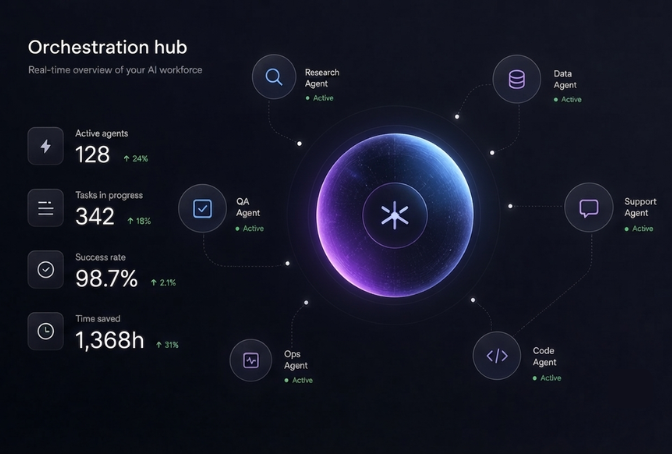

I recall the very moment when I of course understood that the world had silently moved on from ChatGPT. The time was mid 2024 and I read that the procurement system of a company had automatically renegotiated a purchase contract with a vendor, generated a purchase order, sent it to their ERP and sent a confirmation email. Everything without even a human click. No one had typed a prompt. Nobody had “chatted” with an AI. The system had merely done the job.
I have remembered that moment, as it was an ideal representation of what we are going through in 2026. We are beyond the conversational AI to task agents. The chat window has not disappeared, but it is no longer the point. The point is execution.
Chatbot Era Is Not Dead, It Just Got an Upgrade
There is one thing I would be plain with. Something significant was done by ChatGPT and similar tools. They opened AI to the general population. The AI Index Report 2024 published by Stanford University shows that Pakistan is the fourth most aware of the ChatGPT in the world, with 76% of the population aware of this tool. That is an impressive figure considering that the infrastructure gaps and electricity shortages that are still a problem in the country are struggling. Our citizens are inquisitive, they are famished and they embraced conversational AI more expeditiously than anyone in the world.
However, being aware of a chat tool and using AI that actually manages your operations are two very different concepts. The gap between the realization of AI and integration of AI into infrastructure is what 2026 has made more apparent. Better chat responses are not among the prospects of generative AI in 2026. It concerns systems that plan, make a decision and take action.
What Agentic AI Actually Means
The industry term is “agentic AI”, systems that do not just respond to prompts but actively search through many steps, tools, and systems to achieve a goal. Consider the comparison between telling a junior associate to write you a memo and recruiting a project manager who coordinates a team on his own, manages schedules, indicates issues, and delivers outcomes. One responds. The other acts.
The figures below this movement are appalling. In the year 2025, the global agentic AI market reached approximately $7.5 billion and is expected to increase slightly to almost 11 billion in the year 2026 at the compound annual rate of more than 43%. Precedence Research analysts estimate that the market will reach $200 billion by 2034. In context, this is a market that hardly existed three years back.
One of the most obvious predictions of this year made by Gartner is that by 2026, 40% of enterprise applications will have embedded, task-specific artificial intelligence agents, compared with under 5% in 2024. What was experimented within two years has become the norm. McKinsey asserts that 62% of organisations already experiment with AI agents and 23% are actively scaling them to business functions. According to a survey by ServiceNow, 43% of organisations intend to implement agentic AI in 2026.
Real-World Applications Beyond the Chat Window
This is the point where it becomes real. Answers out of the chat window are no longer pilots or proofs of concept. They are dynamic production systems that alter the manner in which an industry functions.
Multi-agent deployment enabled Siemens to realize 90% touchless processing on its industrial processes, which saved the company a yearly cost of EUR 5 million. In the retail sector, a company that was ranked as one of the top billionaires by Forbes provided AI agents to its contact centre and registered a 9.7% increase in new sales calls, 47% reduction in avoidable calls to stores, and an increase of $77 million in annual gross profits. Financial services AI agents are watching fraud, making claims, and making compliance queries without directing a human command.
Accenture estimates that up to $150 billion dollars annually in healthcare will be saved globally once AI applications are used in the healthcare sector by 2026. Agents are taking care of appointments and booking, medical bills, retrieving patient history, and warning systems on inpatient monitoring. IBM research indicates that 4 out of 10 healthcare leaders already implement AI in the clinical setting.
All these instances are bound by the integration of AI systems into infrastructure. They are not 1-click tools that you can open in a browser tab. They are integrated into ERP systems, hospital management systems, logistics systems, finance service processes. The dialogue has ceased to be in the chat window and has found its way to the operating system of whole industries.
Opportunity Inside the Gap For Pakistan
When at this point in Lahore, the truthful image of Pakistan AI stances in 2026 is that of huge potentials alongside true structural limitations. The two parties should be recognized.
On the opportunity side: Statista estimates the AI market in Pakistan to reach the scope of $949 million in 2025 and increase by 27.76% CAGR to 3.23 billion by 2030. By 2030, experts predict that AI will bring between 10-20 billion dollars to the Pakistani economy. IT exports grew by 23.7% in 2024-25. Pakistan is ranked among the fastest-growing AI markets in the world because of a 300% year-on-year increase in the adoption of AI tools. Theoretically, the workforce composition is the best to make the transition with 64% of our population below the age of 30.
The government has reacted by the National AI Policy 2025 which was adopted by the cabinet in July 2025. The policy has a goal of one million AI professionals and 10,000 new trainers by 2030 and 2027, respectively. It provides National AI Fund, centres of excellence and an AI Regulatory Directorate. The policy also has an aim of making 90% of internet users aware of AI by 2026. This has a significance in the regional context. India has an IndiaAI Mission which has been allotted about more than 1.2 billion dollars in a span of five years; Pakistan policy is much smaller in terms of the amount but it is an indication of goodwill.
On the constraint side: we do not yet have local data centres that have significant AI compute capacity. The number of AI-skilled people in the present computing and IT labor force is less than 10% of the total workforce. Supply of electricity is unpredictable in most areas. And there is a greater strategic danger that I continue to increment. The danger of growing to be a nation of AI consumers instead of AI constructors. The consumption of the tools produced by others instead of integrating AI into our infrastructure and exporting solutions.
The Governance Problem
This is what is usually glossed over by the optimism surrounding agentic AI. Gartner also cautions that fewer than 40% of agentic AI projects will be cancelled by 2027 unless organisations develop appropriate governance, observability and definite ROI models. We have already experienced this in markets that are more sophisticated than ours. Firms are putting agents that have no audit trail. The decisions they are automating cannot be explained. They are climbing mountains whose nature is unknown to anyone.
To the case of Pakistan, it literally means that Pakistan is a notch behind the curve of the global domain. Now we are able to examine the governance failures occurring in more developed markets and establish the guardrails at the very beginning. The National AI Policy 2025 of Pakistan has got the right instincts. It specifically includes ethical AI application, data sovereignty, and regulatory sandboxes. The danger is that intentions and actual operations of the policy drift apart, which occurs when action overtakes control. That is one of the risks that we must take active measures against.
What the Future of Generative AI in 2026 Actually Looks Like
Further development of generative AI in 2026 does not look like a smarter chatbot. It is a programmed group of agents that operates supply chains, prepares and files legal documents, control of the flow of patients in a hospital, detects fraud in real time, and makes marketing campaigns without having to type a prompt to a human.
According to McKinsey, AI agents and robots are able to create up to $2.9 trillion in economic value in the United States alone every year. According to IDC, the growth of AI spending in the world per year is 31.9% until 2029. The Asia-Pacific Region is expected to record the highest agentic AI growth rate of any region, having a 44.95% CAGR by 2031. This does not ignore South and Southeast Asian markets. They are key to the place where the next generation of adoption occurs.
This in practice would imply that the companies and governments that are victorious in the upcoming decade will not be the ones that had the most successful chatbot with AI in 2023. They will be those who managed to incorporate AI systems as a basic part of infrastructure both in 2025 and 2026, not as a productivity enhancement but as a platform of operation.
What Leaders in Pakistan Need to know
Whenever I meet CEOs, government officials, and startup founders in Pakistan, the same advice is that I go back to: do not base your AI maturity on how many of your employees are using ChatGPT. Begin a count of the processes in your organisation that do not need a human in the loop.
Name three or five processes in your organisation that are high-volume, rules-heavy and are now relying on manual coordination. Invoice processing. Vendor onboarding. Customer complaint routing. Permit applications. Inventory reordering. These are the very activities in which agentic AI systems are designed to perform. Automated technology to do so is available today. The question is whether or not your organisation possesses the desire and the technical capability to roll it out.
Pakistan has already informed us where the world demand lies through its IT export firms. The international client demand has seen up to 30% of solutions of major exporters of IT being AI-based. Our developers are paid to create agentic systems for businesses in North America and Europe. I am constantly posing the question as to whether we are developing those same systems to Pakistani organisations back home or we are exporting the capability without retaining any of it at home.
The Shift Has Already Happened
Conversational AI to task-based agents is not a development in the future. It has happened. Gartner confirmed it. McKinsey confirmed it. It is proven by the numbers of the enterprise deployments. It is not known whether to work with this shift in 2026. It is the distance behind which you can be content to drop before you are pushed.
In the case of Pakistan, the opportunity window is not limitless. It is our awareness, the young talent, an emerging policy framework, and established international demand for AI-skilled labour. What we are having now is the urgency at the enterprise and governmental level – urgency to cease experimentation and become integration, become awareness and become deployment, and become chatting and doing.
Each month that goes by is one in which another organisation out there in the world has automated a workflow which your team is continuing to do manually. The tools are ready. The compound growth in the global market is at 43% a year. The only variable remaining is to move with it.
I remember the exact moment I realised the world had quietly moved on from ChatGPT. It was mid-2024, and I read that a company’s procurement system had just automatically renegotiated a vendor contract, generated a purchase order, filed it in their ERP, and sent a confirmation email. All without a single human click. No one had typed a prompt. Nobody had “chatted” with an AI. The system had simply done the work.
That moment stuck with me, because it perfectly captured the shift we are living through in 2026. We have moved from conversational AI to task-based agents. The chat window is not gone, but it is no longer the point. The point is execution.
Chatbot Era: Not Dead, Just Got an Upgrade
Let me be direct about something first. ChatGPT and tools like it did something genuinely important. They made AI accessible to ordinary people. According to Stanford University’s AI Index Report 2024, Pakistan ranks fourth globally in ChatGPT awareness, with 76% of the population familiar with the tool. For a country still grappling with infrastructure gaps and electricity shortages, that number is remarkable. Our people are curious, they are hungry, and they adopted conversational AI faster than almost anyone else on the planet.
But awareness of a chat tool and deployment of AI that actually runs your operations are two very different things. What 2026 has brought into focus is the gap between knowing about AI and embedding it into infrastructure. The future of generative AI in 2026 is not about better chat responses. It is about systems that plan, decide, and act.
What Agentic AI Actually Means
The industry term is “agentic AI”, systems that do not just respond to prompts but autonomously pursue goals across multiple steps, tools, and systems. Think of the difference between asking a junior associate to write you a memo versus hiring a project manager who independently coordinates a team, manages timelines, flags problems, and delivers results. One responds. The other acts.
The numbers behind this shift are staggering. The global agentic AI market was valued at around $7.5 billion in 2025 and is projected to reach nearly $11 billion in 2026, growing at a compound annual rate of over 43%. Analysts at Precedence Research project the market will approach $200 billion by 2034. For context, this is a market that barely existed three years ago.
Gartner has made one of the clearest predictions of the year: by the end of 2026, 40% of enterprise applications will include embedded, task-specific AI agents, up from less than 5% in 2024. In just two years, what was experimental has become standard. According to McKinsey, 62% of organisations are already experimenting with AI agents, and 23% are actively scaling them across business functions. A ServiceNow survey found that 43% of organisations are planning to adopt agentic AI in 2026.
Real-World Applications Beyond the Chat Window
This is where things get concrete. The real-world applications beyond the chat window are no longer pilots or proofs of concept. They are live production systems changing how entire industries operate.
Siemens achieved 90% touchless processing across its industrial workflows using multi-agent deployment, saving an estimated EUR 5 million annually. In retail, a Forbes-recognised company deployed AI agents across its contact centre and saw a 9.7% increase in new sales calls, a 47% drop in unnecessary store-bound calls, and an improvement in annual gross profit of $77 million. In financial services, AI agents are monitoring fraud, processing claims, and routing compliance queries without waiting for a human instruction.
In healthcare, Accenture estimates AI applications could generate up to $150 billion in annual savings globally by 2026. Agents are managing appointment scheduling, medical billing, patient history retrieval, and early-warning systems for inpatient monitoring. Four in ten healthcare executives are already using AI in clinical settings, according to IBM research.
What ties all of these examples together is AI systems integration into infrastructure. These are not tools you open in a browser tab. They are woven into ERP systems, hospital management software, logistics platforms, and financial services workflows. The conversation has moved from the chat window to the operating system of entire industries.
Opportunity Inside the Gap For Pakistan
Standing here in Lahore, the honest picture of Pakistan’s AI position in 2026 is one of enormous potential sitting alongside real structural constraints. Both sides need to be acknowledged.
On the opportunity side: Pakistan’s AI market is projected to reach $949 million in 2025 and grow at a 27.76% CAGR to $3.23 billion by 2030, according to Statista. Experts estimate AI could contribute between $10 billion and $20 billion to Pakistan’s economy by 2030. IT exports grew by 23.7% in 2024-25. A 300% year-on-year growth in AI tool adoption puts Pakistan among the fastest-growing AI markets globally. With 64% of our population under 30, the workforce composition is, in theory, ideal for this transition.
The government has responded with the National AI Policy 2025, approved by cabinet in July 2025. The policy sets a target of training one million AI professionals by 2030 and 10,000 new trainers by 2027. It establishes a National AI Fund, centres of excellence, and an AI Regulatory Directorate. The policy also sets a target of 90% AI awareness among internet users by 2026. In the regional context, this is a meaningful signal. India’s IndiaAI Mission allocated the equivalent of over $1.2 billion over five years; Pakistan’s policy is smaller in scale but it signals genuine intent.
On the constraint side: we still lack local data centres with meaningful AI compute capacity. Less than 10% of the current computing and IT workforce is AI-skilled. Electricity supply remains unreliable across many regions. And there is a deeper strategic risk I keep raising. The risk of becoming a country of AI users rather than AI builders. Consuming tools made elsewhere rather than embedding AI into our own infrastructure and exporting those solutions.
The Governance Problem
Here is something the optimism around agentic AI often glosses over. Gartner also warns that over 40% of agentic AI projects are at risk of cancellation by 2027 if organisations fail to establish proper governance, observability, and clear ROI frameworks. We are already seeing this in markets more advanced than ours. Companies are deploying agents without audit trails. They are automating decisions without explainability. They are scaling systems nobody fully understands.
For Pakistan, being slightly behind the global curve is actually an advantage in this specific area. We can study the governance failures happening in more advanced markets right now and build the guardrails in from the start. Pakistan’s National AI Policy 2025 has the right instincts. It explicitly covers ethical AI use, data sovereignty, and regulatory sandboxes. The risk is that policy intent and operational reality diverge, which happens when implementation outpaces oversight. That is a risk we need to manage actively.
What the Future of Generative AI in 2026 Actually Looks Like
The future of generative AI in 2026 is not a smarter chatbot. It is a coordinated set of agents running supply chains, writing and filing legal documents, managing hospital patient flows, monitoring fraud in real time, and planning marketing campaigns without waiting for a human to type a prompt.
McKinsey estimates that AI agents and robots could generate $2.9 trillion in annual economic value in the United States alone. Year-over-year AI spending is growing at 31.9% globally through 2029, according to IDC. The Asia-Pacific region is forecasted to post the fastest agentic AI growth of any region, at a 44.95% CAGR through 2031. South and Southeast Asian markets are not peripheral to this story. They are central to where the next wave of adoption happens.
In practical terms, this means the companies and governments that win the next decade will not be the ones that had the best AI chatbot in 2023. They will be the ones that successfully integrated AI systems into core infrastructure in 2025 and 2026, treating AI not as a productivity add-on but as an operational foundation.
What Leaders in Pakistan Need to know
When I sit down with CEOs, government officials, and startup founders across Pakistan, the advice I return to is this: stop measuring your AI maturity by how many people in your company use ChatGPT. Start measuring it by how many processes in your organisation run without a human in the loop.
Identify three to five workflows in your organisation that are high-volume, rules-heavy, and currently dependent on manual coordination. Invoice processing. Vendor onboarding. Customer complaint routing. Permit applications. Inventory reordering. These are exactly the types of tasks that agentic AI systems are built for. The technology to automate them exists today. The question is whether your organisation has the will and the technical capacity to deploy it.
Pakistan’s IT export companies are already telling us where the global demand sits. Up to 30% of solutions from major IT exporters are now AI-based, driven by international client demand. Our developers are being paid to build agentic systems for companies in North America and Europe. The question I keep asking is whether we are building those same systems for Pakistani organisations at home, or just exporting the capability without keeping any of it for ourselves.
The Shift Has Already Happened
The move from conversational AI to task-based agents is not a future event. It has happened. Gartner confirmed it. McKinsey confirmed it. The enterprise deployment numbers confirm it. The question in 2026 is not whether to engage with this shift. It is how far behind you are willing to fall before you do.
For Pakistan, the window of opportunity is real but not unlimited. We have the awareness, the young talent, a growing policy framework, and proven global demand for AI-skilled labour. What we need now is urgency at the enterprise and government level — urgency to move from experimentation to integration, from awareness to deployment, from chatting to doing.
Each month that goes by is one in which another organisation out there in the world has automated a workflow which your team is continuing to do manually. The tools are ready. The compound growth in the global market is at 43% a year. The only variable remaining is to move with it.