Over the years, the IT industry of Pakistan has made tremendous strides. The market is flooded with budding enterprises, a significant rise has been seen in software exports, and most firms have made it a norm to have international clients as their daily business. However, this advancement has also brought about a certain practice-one which no one in Pakistan really took seriously for a long time. It is becoming more and more difficult to employ talented people.
The past is gone where the work culture of Pakistan was such that the employees would be sticking with the company for years and this was considered a virtue. Nowadays, hiring has become a kind of success, headcounts rise, teams are created and projects are pushed ahead for a lot of companies. But, on social media, in Facebook or Instagram, the focus is on the glamour. Behind the glittering screens of Linkedin posts and team activities, the people who are required to make all that happen are constantly leaving. Continuity is lost in the teams, managers recruit for a much longer time than they work, and long-term strategies are continually altered due to employee turnover. This is not just a small problem in terms of talent retention in Pakistan but has become a part of the operating environment.
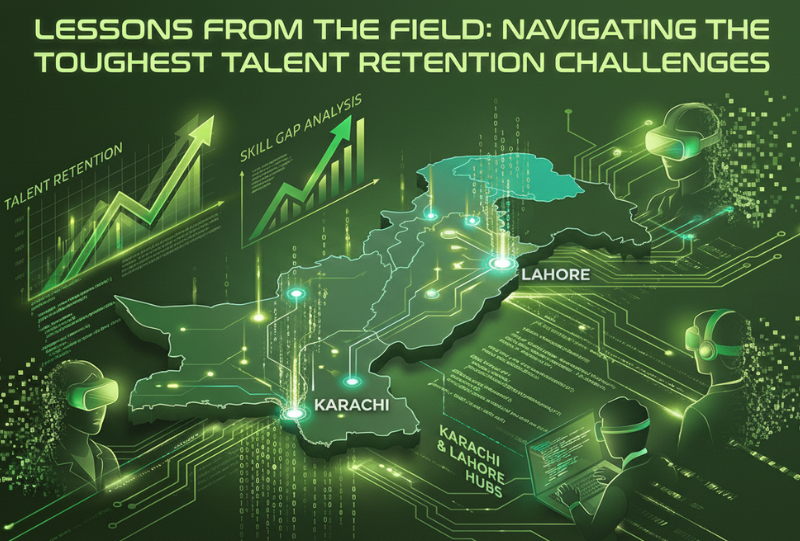
Lahore and Karachi, the two largest tech hubs of the country, are the ones who face this situation directly. These cities have the largest talent reservoirs and the fiercest job competitions. The effects of employee churn in the IT sector of Pakistan are the strongest in these cities. Observing what is going on in these cities is a good starting point for understanding the future of the industry and what realistically can be done by organizations to improve retention.
In this post, I will explain why retention has turned into such a difficult task and what measures companies are taking. The emphasis will be on the real-life situation rather than mere theories of the recurring patterns that I have noticed in real organizations.
The changing nature of job stability in Pakistan’s tech sector
In the past when switching jobs in the IT industry of Pakistan was frowned upon, it still is today. In fact, technical professionals in particular, consider it a normal movement of going from one company to another. The opportunities arise very often, the recruiters do not relent, and good developers generally have several options at any time.
The latest industry data does show this attitude change. 33% of top-notch IT professionals switched jobs in around 2022, lured by high-paying offers, with technical positions accounting for the most movement. This figure is projected to climb in the coming years. The most active job seekers are mid-level engineers and developers. They possess the right amount of experience to be valuable, but at the same time, they are not too set in their ways that they cannot adapt to a new workplace.
Several external factors have further contributed to and entrenched these behaviors. Salaries have been squeezed by inflation, thus compensation has become a more short-term issue than long-term loyalty. At the same time, the availability of remote work has made it possible for foreign employers to hire totally remote workers offering more salaries without requiring their relocation. Many workers find it hard to say no to such opportunities.
From an organizational point of view, the cost of turnover is much more than the recruitment expenses. The process is time-consuming and costly as experts are suddenly leaving and taking with them project knowledge, client context, and informal systems that are hardly documented. The colleagues left behind have to take over and do more work, which leads to frustration and tiredness.
Over time, the impact starts to manifest through low morale and becomes a major factor contributing to poor retention.
Compensation pressure and its limits
The situation in the tech labor market of Pakistan regarding competitive salaries has turned into a very intricate affair because companies are under pressure to keep their salaries according to market trends besides the foreign employers’ competition. Some companies have resorted to measures like dollar-linked salaries, frequent bonuses, or aggressive counteroffers for key employees’ retention.
These measures have a positive effect for a short period. They slow down resignations or prevent movements at once. But compensation alone cannot be relied upon to tackle the issue of retention. Money has a great deal to do with the people who stay on, and they usually are not very engaged after some time. Eventually, discontentment comes back, sometimes even more powerfully than before.
Companies are realizing that salary has now become more of a hygiene factor, rather than an attraction. Employees just want the salary to be competitive. If it is not, they leave instantly. If it is the case, they will soon start looking into other facets of their work experience.
Skills, learning, and the retention connection
The skill gap in tech in Pakistan has been one of the main reasons for the retention problem. Universities keep on getting and giving out thousands of fresh graduates but still, a lot of them need a lot of time and training before they can get and become productive. Companies often make this as a reason to put a lot of time and resources into this, usually without a clearly defined long-term learning and development framework.
For the workforce this can turn out to be a mixture of good and bad vibes. On the one hand, early exposure and training are highly considered but on the other hand, often progress is just stuck at the initial skill level. When learning turns into something informal or accidental, people start thinking that their development is more reliant on luck than on the system.
This is the point where retention mostly starts to deteriorate: the skilled employees want to see that their skills will continue to be developed. If they do not see structured learning, mentorship, or challenges that help them grow, they are looking for a job in another company. In many cases, the decision to leave is not so much about the pay but rather about not wanting to get stuck in one position.
Career progression and clarity
The technology skill gap that exists in Pakistan has been one of the major factors that contributed to the high employee turnover. The universities keep on taking in and sending out thousands of fresh graduates every year, but still, a lot of them will have to wait a long time and go through a lot of training and become productive. Companies frequently make this as an excuse to invest a lot of time and resources into this, usually without a clearly defined long-term learning and development framework.
The situation can be viewed by the employees as a mix of good and bad vibes. On the one hand, early exposure and training are seen as very important but on the other hand, progress is often just stuck at the initial skill level. When learning becomes informal or accidental, people come to believe that their development is more dependent on chance than on the system.
This is the point where retention mostly starts to deteriorate: the skilled employees want to see that their skills will always be developed. If they do not see structured learning, mentorship, or challenges that help them grow, they are looking for a job in another company. In many cases, the decision to leave is not so much about the pay but rather about the unwillingness to get caught in a position.
Work-life balance in practice
The issue of work-life balance in Pakistan’s IT sector is still a delicate one because of factors like international clients, tight deadlines, and time zone differences that prolong working hours. Although many companies recognize the need for a work-life balance, they do not provide consistent support for flexible arrangements. This inconsistency is of great importance for the younger workforce. Many of them consider autonomy and flexibility to be as important as compensation, and the lack of clear or stable expectations regarding availability increases the risk of burnout.
Hybrid models or outcome-based tracking of performance are among the most commonly used methods in organizations that report morale gains. These methods are signs of trust and respect, which can further solidify long-term commitment.
Culture, management, and everyday experience
In Pakistan, the day-to-day behavior of managers has an effect on the whole process of talent management. The employees mostly perceive their direct manager as the representative of the company. When there is lack of feedback or recognition, or when the communication is one-way, dissatisfaction increases among the workers.
The resignations of many employees are presented as career changes, but in fact, they often stem from unresolved discontent with management or corporate culture. Besides, companies with powerful brands and attractive salaries can still face the challenge of losing their employees if the daily atmosphere at the workplace is unfriendly.
What the data and field experience suggest
Research in Pakistani IT companies has confirmed that retention strategies have an indirect but measurable effect on the workforce. Enhanced career development, better financial planning, flexible schedules, and recognition are majorly linked to the employees’ higher intention to remain in the company.
Moreover, the traditional performance reviews do not have a significant impact on their own but in combination with proper feedback and development discussions they do. Workers get to be more receptive when their evaluations lead to real development rather than just ratings.
The company’s providing better treatment such as welfare benefits is another factor to retention. Retirement plans and education assistance are commendable, even when they are not immediately used; these benefits show that the employer is committed to a long-term relationship, which can influence the decision to leave or stay over a longer time frame.
Moreover, the demographic factors add depth to the picture. Employees in the younger age group usually move more often than those with higher education who often prefer places with high flexibility and low pay stability. The duration of employment affects the perception of the company’s retention strategies, the workers who have been there for a longer time responding very positively to the company’s HR practice in terms of clarity and consistency.
In the case of BPO and ITES, reskilling has become the primary strategy for continued retention. The repetitive nature of the jobs contributes to a great turnover, but the chance of being promoted to a higher-value position not only engages employees but also boosts their performance.
Lahore and Karachi as distinct retention environments
Retention pressures in Lahore and Karachi are similar in nature, yet the dynamics of the two cities differ significantly in some major areas. Lahore’s tech hubs are still quite young and largely opened up by the startups. The employees want training, mentoring, and wide exposure to different projects at the places where they work. Sometimes, the turnover of the people is very rapid and is driven by the need to know as well as by the pay.
Karachi’s tech hubs contain more enterprise-scale firms and operations that are focused on the export market. Salaries are most competitive, and usually, the HR structures are more formal, where the delivery pressure is high and burnout is common. Retention here relies heavily on the provision of manageable workloads and the support of the management.
Such differences also highlight the necessity for different approaches for different cities. The retention strategies that have done well in one hub may have to be adjusted for the other.
What organizations are learning from experience
By frequently utilizing counteroffers, companies frequently get caught in a loop. Though the employees might not leave immediately, the problems that drove them to consider leaving are still there. Ultimately, this route is expensive and not very fruitful at the same time.
On the contrary, companies that are serious about career development have a more permanent workforce. The combination of structured learning paths, internal mobility, and visible commitment to skill growth creates an environment of constant development. It is where the development of employees is genuinely supported that they show the strongest loyalty and are thus more likely to stay even during difficult times.
Flexibility in the workplace has also been recognized as an important factor by organizations. Flexibility can reduce stress and improve retention when offered in a very thoughtful manner with the understanding that it requires trust and clear expectations.
The influence of culture may be subtle but it is nonetheless powerful: the departments that perceive each other as more collaborative and respectful tend to last longer. An illustration of this can be the interaction of leaders who listen, communicate clearly, and treat people as unique.
Leadership, HR maturity, and technology
Retention is, in the end, a mirror of the leadership’s priorities. The executive teams and CTOs who consider the people strategy a part of the business strategy are the ones who experience the most benefits. The leadership vision determines the allocation of resources and the making of trade-offs. My vision at ibex, for example, will be the basis for the technological aspect alongside CTO Jamshaid Mustafa.
The adoption of international best practices in HR is becoming important, especially for firms working for international clients. Transparency in performance management, benchmarking by salary surveys, and the use of professional HR systems all contribute to building a certain level of credibility and trust within the organization.
New or upcoming AI talent retention strategy is always creating a buzz around it. The AI tools could help in the early detection of attrition risks and skill voids, thus allowing the organizations to take their time and act before the issue escalates, but only if the usage of such tools is responsible.
Looking ahead
The IT sector of Pakistan still has a few challenges in terms of retention and these are not going to be resolved easily. A short-term solution may be acceptable but for a long-lasting improvement, it has to be a wider view: wage and salary are at the forefront of employee concerns but also professional growth, culture of the organization, flexibility, and managerial behavior have an impact.
Doing so will imply human resource systems be given the same priority as those of technology and sales in an organization. At a higher level, this will imply cooperation among industry, educational institutions, and government on the long-term development of skills.
Organizations ready to explore and analyze retention deeply are in the position to provide consistently, win-up strong customers, and expand with certainty. In a market of cut-throat competition, the capacity to keep the best people might just be one of the most significant advantages that a tech company can have.