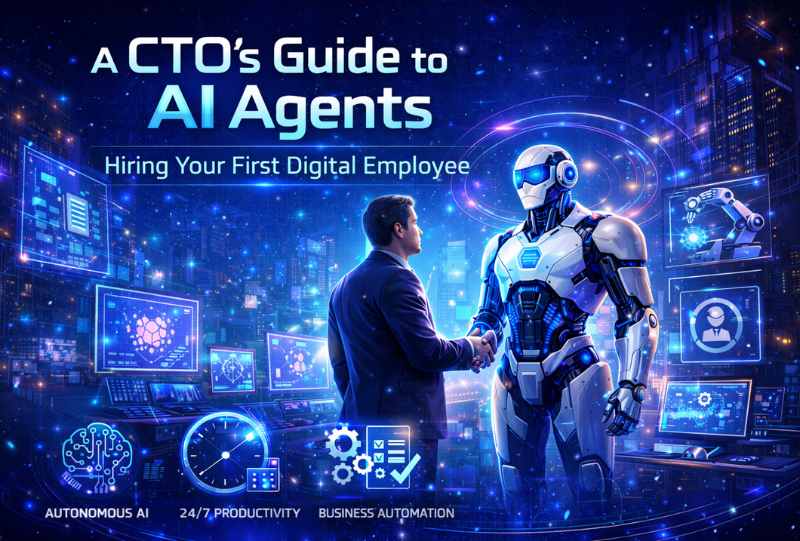
There is a paradigm shift in the technology environment. As much as businesses have been experimenting with the inclusion of AI in certain processes in the previous decade, we are currently entering the period of autonomous AI agents, or digital workers that can complete complex, multi-step work flows with little to no human supervision. This is an unprecedented opportunity and a keystone strategic decision to CTOs: how do you recruit your first digital employee?
Understanding Autonomous AI Agents
One must know what makes autonomous AI agents unique compared to other automation tools before getting into the development process of the agent. As opposed to the rigid and rule-based automation systems, autonomous AI can sense their surroundings, make judgments, act based on the results, and learn; that is, they can perform those actions, to reach a specific objective. They are the development of the if-then programming into intelligent, adaptive systems capable of dealing with the ambiguity and complexity.
Consider independent AI actors as your own AI agent to business processes, a digital teammate, not an actor who simply follows the programmed instructions but a creative problem-solver, adjusts to novel circumstances, and gets better at its tasks over time. To the business it can be seen to mean that companies should not stop by automating tasks but rather they should develop an agentic labor force that has the capacity to handle whole fields of operation.
The Strategic Case for AI for Businesses
The economic sense of employing digital workers to automate the enterprise is not merely in cost-cutting. Where conventional workers need to be onboarded, trained, provisioned, and put into a working environment, AI agents are 24/7, need no breaks, scale immediately, and perform equally well under pressure. But their true worth is in their capacity to deal with the high volume, repetitive jobs which are crippling your human resources and leaving your team to do strategic, creative jobs.
Proactive CTOs understand that measures of AI agent performance show that their use yields a real ROI in various aspects. Digital workers minimize data processing errors, help speed up customer service work, and allow decisions to be made at scale in real-time. What is more important is that they generate competitive advantages, as they enable organizations to run faster and on a bigger scale than it would have occurred previously when organizations used human-only teams.
What is The AI Agent Lifecycle?
The lifecycle of the AI agent is vital when any CTO is going to take this journey. The lifecycle usually involves five major stages that include ideation and use case selection, development and training, testing and validation, deployment and integration and continued monitoring and optimization.
- Ideation stage: Teams discover processes that are repetitive, rule-based but complex, data-intensive and are currently limited by human capacity. The initial candidates are good and they are data entry and validation, customer querying and first response, report generation and distribution, monitoring and alerting system and compliance checking and documentation.
- Development phase: This contains the task of choosing the appropriate AI architecture for your application, educating the agent to be responsible about your individual data and processes, and incorporating suitable guardrails and human-in-the-loop inspection points. This is the stage where the engineering team, domain experts and the business stakeholders need to work closely, in order to make sure that the agent is aware of not only the technical requirements, but also the business environment and constraints.
Building Your Agentic Workforce
The formation of an efficient agentic workforce should not only be seen in terms of agents but also in terms of agents collaborating as a system in totality. Your digital employees require roles, workflow, and coordination mechanisms just like any other team. Certain agents may be data collectors, others data analysts and others report and communicate.
The important thing is that you should plan your agent development process with AI in a modular way. Begin with one, clear-cut use case as opposed to trying to automate whole departments in one night. After demonstrating value and setting the best practices, you can grow your agentic workforce in a systematic way. In this way, you can learn, repeat, and gain confidence in autonomous systems by an organization.
Reflect on the establishment of a hierarchy among your agentic workforce. Basic agents are used to carry out mundane chores, whereas more advanced agents are used to make detailed decisions. Orchestration agents are able to manage coordination of various specialized agents, similar to the human project manager managing the team members. Such graded solutions offer effectiveness and due supervision.
How to Integrate AI Agents into Existing Tech Stacks
The problem of how to deploy AI agents into the current tech stacks without disturbing current activities is one of the most crucial issues that CTOs are struggling to resolve. Better still, the current AI agents are able to integrate into your existing infrastructure via APIs, webhooks and integration platforms.
Begin with mapping your present technology ecosystem. Determine the systems your AI agent will need to touch on- your CRM, ERP, databases, communication systems, and business intelligence systems. The vast majority of AI agent platforms come with pre-existing integrations with popular enterprise software, although specialized connections might be required with proprietary systems.
The most important issue during onboarding AI agents is security and access control. Digital employees should be treated as human employees: they should be given the right access to resources, authentication, authorization measures must be applied, and audit of any activity performed by an agent must be provided. Your AI agents ought to be part of your and not beyond your current security system.
It would be well considered to have a middleware layer between your AI agents and core systems so that the interface is controlled. This abstraction layer offers the flexibility to update, replace or modify the agents, without accessing the production systems, lowers the risk, as possible errors are confined and the monitoring and logging of the agent activities becomes simpler.
Onboarding AI Agents: Your Digital Employee Checklist
As with the human work force that must be provided with structured onboarding, the process of hiring digital employees to do the automation of the enterprise requires a systematic approach. The onboarding process outlined above should entail the definition of clear goals and success metrics, the setting of performance baseline and KPIs, access control to the systems and data required, the use of monitoring and alerting mechanisms, and the development of paths of escalation of edge cases and errors.
Onboarding is very crucial in documentation. Prepare detailed run books outlining the role of:
- The agent
- Logic of decision
- Integration areas
- Exception case treatment
This documentation is multiple-purpose. It helps to ensure consistency, troubleshoot, meet compliance and audit requirements, and transfer knowledge as your team grows.
It is also important that you train your human team. Your employees should learn what the AI agent can and cannot perform, how to cooperate with its digital colleagues, how to track and analyze the performance of the agent, and in what and when to intervene. This model of human-AI co-operation is needed to achieve the maximum value out of your agentic workforce.
The CTO Blueprint for Managing Autonomous AI Teams
It is necessary to reconsider the conventional management methods when creating a CTO roadmap to lead autonomous AI staff. They do not require motivation or career advancement as AI agents do require constant monitoring, retraining on a regular basis, and regular enhancement.
Implementation of clarity in the AI agent performance indicators relative to the business goals. These could be the rate of completion, accuracy of tasks to be completed, processing rate and throughput, error rate and error type, the transaction cost per transaction and user satisfaction scores. Frequent performance reviews enable you to see which areas can be optimised, to notice performance decline or deterioration and to rationalise further investment and growth.
The greater your agentic workforce, the more important governance becomes. Form a steering committee that will authorize the new AI agent releases, assess the performance of your digital workforce, and define the ethical standards and safeguards and make sure that you meet regulatory demands. Such a form of governance will make sure that your teams of autonomous AI do not go astray of organizational values and goals.
Risk Management and Ethical Considerations
All CTOs need to respond to threats and ethical concerns of implementing autonomous AI agents. Openness is essential, the stakeholders must know when they are communicating with an AI agent and not with a human being. Establish proper disclosure systems, especially the agents dealing with customers.
Think about the possibility of bias in decision making of your AI agents. When an agent is trained with historical data which has historical biases, it can continue or even increase the biases. Use periodical bias audit, heterogeneous training data, and human supervision of high-stakes decisions. The personal AI of your business processes should be an extension of your organizational values and not some past injustices.
Plan for failure modes. There is no flawless system and AI agents can sometimes fail or be in a state that they cannot manage. Make your systems gracefully degradable – an agent that fails to do a task should not fail in silence or penetrate without making assumptions it should escalate instead.
Measuring Success and Scaling Your AI Workforce
The initial digital employee should be successful in several dimensions. Short term measures are the improvement of operational efficiency, reduction of costs and improvement of the error level. Nevertheless, strategic advantages like better customer experience and increased analytical function and better employee satisfaction should not be neglected because automated tasks eliminate tedious ones.
When you have managed to achieve success in your initial deployment of AI agents, then create a means of scaling. Determine the subsequent highest value use cases, learn lessons related to your initial deployment, and develop institutional knowledge regarding the development and management of AI agents. A large number of organizations discover the second and third AI agents are deployed more successfully and quickly than the initial as the teams gain experience and confidence.
Think of establishing a centre of excellence in AI agents in your organization. With this centralized unit, best practices can be developed, advice and support can be achieved during new deployments, any shared infrastructure and platforms can be managed, and uniformity and quality may be applied throughout your agentic staff.
The Future of Work: Human-AI Collaboration
When you are recruiting your first digital worker, it is important to keep in mind that the aim is to enhance human potential not to displace human workers. The most effective uses of autonomous AI agents are the relationships that form between human and digital employees in which digital workers will process repetitive and high-volume work even as human workers target creativity, strategy, solving complex problems, and relationship building.
This model of collaboration needs to be culturally changed as much as it needs a technical implementation. Make your organization see that AI agents are opportunities that can help increase human potential and not a threat to jobs. The most innovative organizations are leveraging the productivity benefits of their agentic employees to skill employees, seek new opportunities in the market, and innovate.
Taking the First Step
To those CTOs who are willing to employ a first digital employee, the best place to begin is by being strategic but thinking big. Start with a clearly defined use case with a clear value and complexity that is manageable. Establish the technical infrastructures and governance systems to serve not only a single agent, but a growing agentic labor force. And invest in change management needed to carry your organisation along this transformation process.
It is the age of independent AI agents. It is not about whether your organization will be able to hire digital employees, but rather about how fast and efficient you will be in incorporating them into the organization. Through a well-organized strategy to the development process of AI agents, carefully incorporating AI agents into the current tech stacks, and effective implementation of governance and performance management, the CTOs will be able to overcome the transition and place their organizations in the future of work.
Your first digital employee is here. It is high time to begin hiring.