I have spent more than twenty years as a CTO building systems that companies depend on every day. I have seen many technology cycles come and go. Client server. SaaS. Mobile. Cloud. Each wave came with hype, confusion, and eventually clarity. AI is no different.
Right now, one of the most common points of confusion I see in boardrooms and product discussions is the difference between AI agents and agentic AI. These terms are often used synonymously. They are not the same at all. I talked about it briefly in a previous blog, and if you’ve followed me long enough, on LinkedIn as well. This misunderstanding leads to poor architecture decisions, inflated expectations, and unnecessary risk that often harms teams and the company.
The goal of this article is to explain what an AI agent actually is, what agentic AI really means, how they differ, and why those differences matter for your business in 2026 and beyond.
Why AI Terminology Suddenly Matters So Much
In earlier phases of software, sloppy language was annoying but rarely dangerous. With autonomous systems, language shapes expectations. Expectations shape investment and investment shapes risk.
When my fellow c-suites ask me whether they need “agentic AI,” what they are usually asking is whether they need more than a chatbot. Sometimes the answer is yes. Often, it is not. While most may think integrating AI into their organization is the big 2026 solution
Understanding the distinctions between stateless AI and agentic workflows is now a business requirement, not an academic exercise.
What Is an AI Agent?
Let’s start with the most asked question: what is an AI agent?
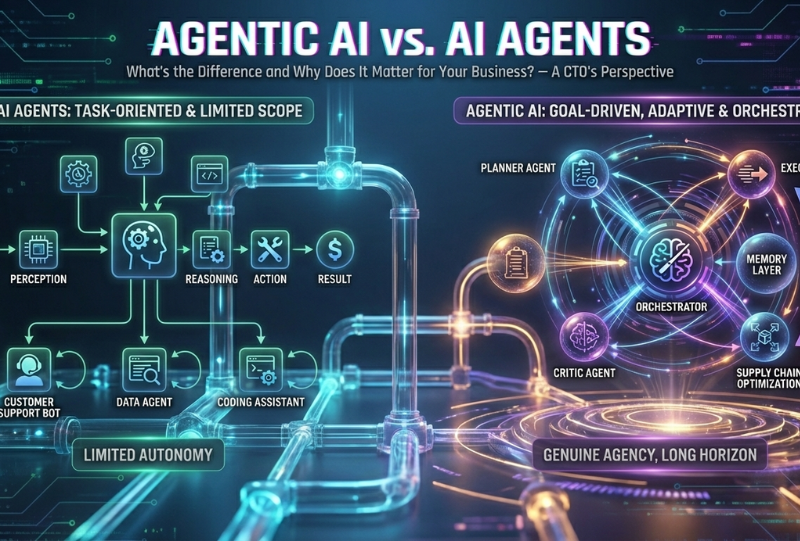
An AI agent is a system that can observe input, make a decision, and perform an action. In modern systems, that usually means a large language model connected to tools, APIs, or databases.
From an engineering perspective, an AI agent usually includes:
- A perception layer that receives prompts or data
- A reasoning step that decides what to do next
- An action step that calls a tool or returns an output
This is the agentic definition most vendors quietly rely on when marketing “AI agents.”
Key Characteristics of AI Agents
AI Agents have limited autonomy due to their smaller scope and a short planning horizon. They have a narrow task scope and do minimal learning over time because usually, they are stateless or only lightly stateful.
Most chatbots, support assistants, scheduling tools, and summarization systems fall into this category.
Types of AI Agents You See Today
With how the world is progressing, we have AI Agents all around us, deeply embedded into company systems. Customer support agents that answer questions and data agents that query dashboards or spreadsheets are some of the biggest examples we see in our daily lives. Ecommerce brands, banks, universities, etc. usually have these on their website landing pages. Another example is coding agents that generate or modify code. Many tech companies have this incorporated into coding systems like GitHub Copilot and Google’s Jules to make developers’ work more efficient. Additionally, workflow agents that trigger predefined automations are something most companies are looking into right now and those who stay ahead of the curve have already integrated.
These systems are useful because they are cost effective and solve real problems. BUT, remember: \they do not have true agency.
Agency vs Automation: The Critical Distinction
This is where confusion usually starts.
Automation follows instructions. Agency interprets goals.
An automated system executes predefined steps. An agentic system decides which steps matter, when to take them, and how to adjust if something changes.
An AI agent can exist without agency. Traditional chatbots are a perfect example. They respond well, but they do not think independently. They do not set goals. They do not adapt strategy over time.
Agentic AI does.
What Is Agentic AI?
Agentic AI refers to systems with genuine agency. These systems can reason, plan, act, and adapt over extended periods with minimal human supervision.
From a CTO’s perspective, agentic AI is not a single model or tool. It is an architecture.
Core Capabilities of Agentic AI
This is where distinctions between AI agents and agentic AI become obvious. One responds. The other operates. Some core capabilities include:
- Persistent goals
- Long horizon planning
- Continuous learning
- Memory across interactions
- Adaptive execution
- Proactive behavior
The Architectural Difference That Changes Everything
AI Agent Architecture
AI agents usually follow a closed loop:
- Receive input
- Decide action
- Execute tool
- Return result
The loop resets after each task. Context may exist briefly, but there is no true continuity.
Agentic AI Architecture
Agentic AI systems are layered and persistent. It goes something like this:
- The perception layer collects signals of the users, systems and environments.
- The reasoning and planning layer breaks down the goals into tasks.
- Memory layer is used to store short term, long term and episodic knowledge.
- Action layer implements vehement decisions amongst tools and systems.
- Feedback loop reviews the results and changes behavior.
My comparison explicates the disparity in the stateless AI and agentic workflows. Stateless systems respond. With agentic systems, there is remembering, planning and improving.
Single Agent vs Multi Agent Agentic Systems
The agentic AI is based on the collaboration of several specialized agents in many cases.
Single Agent Agentic Systems
- One agent strategizes, implements and reviews.
- Easier to build
- Limited scalability
Multi Agent Agentic Systems
- Planner agents define strategy
- Executor agents perform actions
- Critic agents assess outcomes
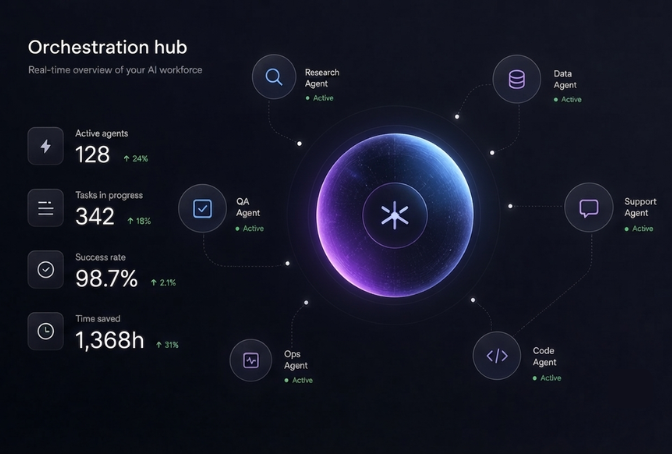
- Everything is organized by orchestrator agents
This is resembling the way real organizations operate. It is a strong yet dangerous similarity.
Why Orchestration Is the Real Innovation
Orchestration is the component of agentic AI that is least addressed. In essence, orchestration refers to the process of coordinating and controlling a group of computer systems and connecting or course linking various functions to accomplish a bigger workflow or process.
A planner delegates, coordinates, and addresses relationships, conflicts, and ensures that the system remains in line with overarching goals. Multi-agent systems fail to work without orchestration in the face of their complexity.
This is what ends up failure in many of the experiments done at the initial stages.
Real Business Example Comparison: Customer Service
AI Agent
It is the model that has been already deployed by the majority of CX firms into their workflows. The AI agent responds based on a script, and it is trained on certain simple CX DATA as well as, in case it is slightly sophisticated, SLAs as well. Its routing is normally done on the basis of keywords and goes out of control when the rules are depleted. These are made minimal on account of having customers who may have quick answers to frequently posed questions.
Agentic AI
This is a paradigm that is being implemented by large technically advanced firms only. It is very expensive to design and requires a great degree of detail and attention. The agentic AI knows the history of customers and recognizes systemic root causes. It dynamically changes priority and tone and eliminates repeat problems.
This difference directly answers why your company needs more than a chatbot in certain environments.
Enterprise Use Cases That Actually Justify Agentic AI
Compliance Monitoring
- AI agent flags rule violations
- The agentic AI explores reasons, evaluates the risk situation, and prescribes.
Risk Assessment
- AI agent calculates preset risk scores
- The agentic AI identifies the emerging trends in information sources.
Supply Chain Optimization
- AI agent reports delays
- The agentic AI balances out the suppliers, inventory and logistics in real time.
These are concrete use cases for agentic AI and AI agents, not hypothetical pledges.
Business Impact of Autonomous AI Agents in 2026
By 2026, the business impact of autonomous AI agents will be defined by restraint, not ambition.
At the winning companies, simple agents will be employed where predictability is of value, agentic AI will be used where adaptation can bring real value and spend a lot of money on governance.
There is an enhancement of ability and danger by agentic AI. Such a tradeoff should be deliberate.
Risks You Cannot Ignore
Technical Risks
- Goal drift
- Memory corruption
- Coordination failures
- Hallucinated reasoning
Ethical and Governance Risks
- Accountability gaps
- Over automation
- Loss of human oversight
Security Risks
- Tool misuse
- Prompt injection
- Unauthorized actions
These dangers increase in autonomy. They are not at the same level as basic agents.
Governance Is Not Optional
Any agentic system should be made up of:
- Human in the loop gateways
- Permissioned tool access
- Action auditing
- Clear rollback mechanisms
Unregulated agentic AI is a setback in regulated industries.
Choosing the Right Approach for Your Business
Here is the advice I give every leadership team.
Choose AI Agents When You Need:
- Interfaces to existing data
- Routine automation
- Predictable outcomes
- Lower cost systems
Choose Agentic AI When You Need:
- Decision making independence.
- Cross system coordination
- Proactive problem solving
- Adaptive long term behavior
Most companies need both.
Cost Reality Check
AI systems that are agentic are more intricate and costly. A lot of teams spend excessively in pursuit of the autonomy that is unnecessary.
In most instances, a properly designed AI agent can provide eighty percent of the value at a fraction of the cost.
Buzzwords are beat every time by fit.
The Future of Agentic AI and AI Agents for Automation
The future is hybrid.
We will see:
- Smaller AI agents that deal with particular tasks.
- High value workflow agentic systems.
- Obvious distinctions between independence and command
This equilibrium will be characteristic of successful AI platforms in the next decade.
Final Thoughts
After two decades in technology, one lesson keeps repeating. Power without discipline brings about more problems than development.
Agentic AI is powerful. AI agents are practical. Misinterpreting the two fails to make good decisions.
Understand the difference. Match autonomy to need. Build governance early. And keep in mind that a smart system that thinks on its own is needed in not every problem.Sometimes, a well behaved agent is exactly what your business needs.