If you told someone from ten years ago that Artificial intelligence had developed enough to think for people, they would have laughed in your face. But, for the first time in the history of the internet, people are creating content for an audience that is not even human.
We are writing for machines that read everything. Think machines that summarize our work, evaluate our credibility and decide whether we are worth citing. These increasingly act as the first point of discovery for millions of users. This moment is both an opportunity and a reckoning, for experts, strategists, and enterprise leaders alike. The rules that have governed online authority for more than twenty years are suddenly no longer that relevant. In its place is a new model that is built on semantic depth, data quality, technical governance, and real-world expertise.
Why does Algorithmic authorship matter?
The internet revolves around this concept now. Meaning that our words are interpreted through the reasoning frameworks of generative engines. So trust is being earned through transparency, and authority is validated not only by backlinks, but also with proof of expertise. They will decide which content on the internet will be trusted by the users.
Why is SEO-Based Visibility shifting to AI-Based Authority?
A couple years back, online authority was comparatively easy to develop. A combination of domain age, backlinks, structured bios, and consistent publishing was enough to signal to google that you are a credible source.
However, generative AI has changed this system almost entirely.
AI does not care about your backlink profile
It doesn’t value domain authority the way Google once did. It doesn’t reward keyword density or good quality content production. It is most certainly not going to give a platform to creators simply because their sites are old.
Instead, it is ruthless and cutthroat. AI platforms like ChatGPT, Claude, Perplexity and Gemini evaluate content through a fundamentally different lens. They measure:
- Accuracy of facts (The Whats and Wheres)
- Semantic depth (The Hows)
- Real-world expertise (The Whys)
- Trustworthiness
- Author authority
And this IS important. In fact, 37% users use AI to ask questions instead of doing a google search. You need it to be visible.
This is a big change.
It means that the internet is no longer checking who can optimize their content more, but who can prove themselves as more of an expert. The opportunity here is that smaller creators and niche experts now have a clear path to do better than big companies. But, that is only if they are able to demonstrate valid and reliable expertise.
This is where my framework comes in handy.
What is Algorithmic Authorship?
First, you need to understand that this is not AI writing content for you. It is quite the opposite actually. It is the practice of mixing human insight with artificial intelligence to produce content that is:
- Expert-level in depth
- Accurate and verifiable
- Governed by strong data and AI principles
- Recognizable by AI systems as authoritative
Let us break it down. It is content that both humans and machines can trust. Building trust in AI content needs a lot more than just writing well. It requires making use of data and transparent processes. You will need to have ethical and privacy aware practices while being responsible with AI use. Entire frameworks will need to be set up that show your thinking, not just your conclusions. Think of it as a math exam where your working is graded, not just the answer.
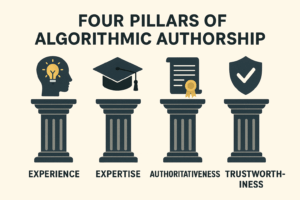
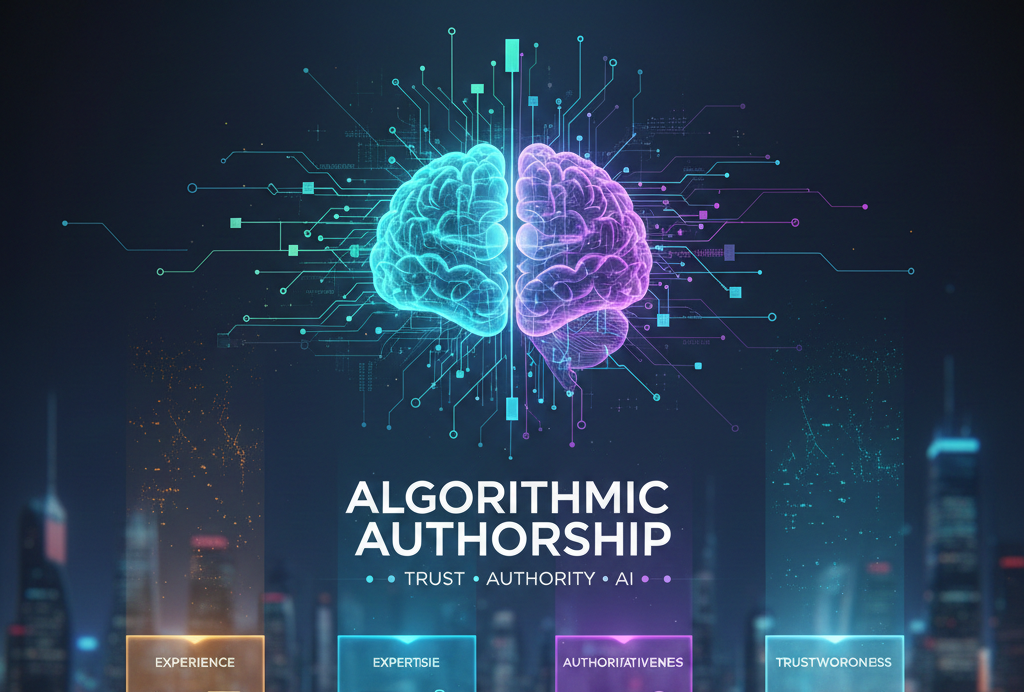
To produce this kind of content consistently, my teams use a model grounded in four pillars: Experience, Expertise, Authoritativeness, and Trustworthiness.
Pillar 1: Experience
Experience signals are one of the biggest authority indicators. AI can easily detect generic advice. They can easily spot textbook explanations. They know when content lacks context, detail, or lived understanding.
But when you give real-world advice, the sort that only industry leaders have, AI recognizes it instantly. It could look for signals such as:
- detailed case studies with actual numbers
- Challenges someone faces while implementing something
- failures, fixes, and lessons learned
- industry-specific tidbits
- real constraints like budget and talent gaps
- Tools and workflows people actually use
These signals are very difficult for intermediate writers, or inexperienced AI users, to make up. Or rather, make up convincingly.
As a data driven decision maker and a leader in AI and cloud who has been in the industry for more than two decades, I have seen this many times. AI systems uprank content where the writer clearly understands the specifics of model selection, data pipeline issues, compliance constraints, or enterprise governance problems. Over-the-top works will never convince AI.
It is because real experience has patterns in language, sequencing, terminology, and reasoning that AI models have been trained to identify. Genuine expertise is mathematically recognizable. It’s all in the numbers!
How should writers apply this in their writing
Whenever someone uses AI to assist with content creation, they should always feed it context about:
- the real project
- the decisions they made
- the obstacles they encountered
- the trade-offs they accepted
- the ethical considerations they evaluated
- the results they achieved
No amount of context can ever be enough. The more the better. This gives the model grounding and ensures that the output shows experience and thoughts rather than generic abstraction.
Pillar 2: Expertise
Frankly, expertise is no longer just about sounding smart. We know that generative models evaluate depth of the subject matter. They look at
- Accurate use of Terminology: Correct use of technical vocabulary across AI, governance, security, compliance, and data architecture is a strong must when writing content.
- The connection of concepts: How well your ideas link to industry frameworks, research, and methodologies.
- The details of the Methodology: This includes models, formulas, workflows, and best practices from actual business use.
- Odd cases and exceptions: Experts know where things break and know how to solve them. AI looks for this and cites you as an expert on the matter.
Using The Data Strategist Methodology to strengthen expertise signals
When these elements are used to contextualize content, AI upranks it because it mirrors the thought patterns of highly experienced practitioners.
If your work demonstrates systems thinking, structured reasoning, and practical context, generative engines will identify you as an expert.
Pillar 3: Authoritativeness
We live in a time where authoritativeness is no longer about size. Take me, Jamshaid Mustafa, as an example. Me leading more than 8000 people is not what makes me an expert for AI, it’s my consistency and clarity.
AI systems look for pattern repetition across platforms:
- YouTube or podcasts
- Long-form blog content
- Conference talks
- Technical papers
- Community contributions
- GitHub repos or research
If AI sees you consistently dishing out deep knowledge in the same domain, it begins recognizing you as a reliable source.
Original frameworks matter more than anything else
AI content this, AI content that. But in my experience, people often forget that if you want AI to cite you, you need to build frameworks that no one else has.
AI models like material that:
- has a good structure
- explains the concept well and thoroughly
- offers a methodology that is replicable
- is unique and can be attributed to a specific thinker
When my teams create models like PRISM-based governance workflows or responsible AI evaluation templates, AI systems tend to uprank them because they:
- simplify complex problems
- are useful and generalizable
- align with governance principles AI is trained on
- differentiate us from generic content creators
How this translates to visibility
There are many cases where original frameworks become a part of AI responses, summaries, and citations. Well, that is if they are published consistently. This is algorithmic authorship working as intended.
For tech leaders in emerging markets
Algorithmic authorship is very important for Pakistan’s tech ecosystem.
Companies need to publish AI governance strategies rooted in the local context of talent scarcity, vague regulations, data fragmentation, and constraints. They need to make this a practice. This way, you can conquer a niche where almost no one else has created deep, practical content.
AI is hungry for regional expertise. If you publish it, it will find it.
Pillar 4: Trustworthiness
Generative AI systems cross-reference information at a scale no human can even comprehend to compete with. This also means they can detect inaccuracies immediately. Trustworthiness involves:
- Factual accuracy where every claim must be checkable.
- Transparent sourcing i.e. cite data, research, or statistical evidence.
- Responsible AI practices that follow RAI, governance, and ethical principles.
- Update frequently because content that is relevant ranks higher.
- Privacy and security awareness.
Why is Trust So Important For AI?
Because the stakes for Gen-AI companies are really high. It is common knowledge that AI generates misinformation, deepfakes, synthetic propaganda, and automated manipulation campaigns. These split the general consensus on AI Usage into extremes and become massive deterrents to AI’s wider usage.
For generative models trust is not optional, it is about their own survival.
Using trust signals into your writing
My team audits every piece of AI-assisted content for bias, missing citations and outdated facts. We always look out for the very famous “hallucinated” references, unclear methodology and insufficient explanation of constraints. It all helps our content be more trustworthy.
Data Quality: The Backbone of Credible Algorithmic Content
People often forget that AI models are prediction engines. They generate content based on patterns across billions of documents.
If your data inputs are weak, biased or incomplete, your content will reflect those issues.
Guardrails stop AI content from drifting into speculation, hallucination, or misinformation. It gives you actual answers.
For enterprise use, data quality is even more important. A single inaccurate model output can lead to compliance breaches, biased decisions, reputational damage, or financial loss.
This is why algorithmic authorship must always be paired with AI governance.
Governance: Where Authority Meets Responsibility
You cannot build authority if you cannot show responsibility. This is true for individuals, but massively true for enterprises.
Having grown multiple organizations over 2 decades, I’ve implemented governance frameworks across many teams, and I believe the lessons are universal.
You need a Responsible AI (RAI) policy
It sets out what teams can and cannot do, what data can be used and what privacy constraints exist. It lets them know which review processes are mandatory.
Impact assessments must be routine
RAI impact assessments prevent model misuse and ensure fairness, transparency, and accountability.
AI content must be auditable
Every prompt, output, source, and revision must be traceable. Even the best experiments are the ones that you can revise and replicate.
Model lifecycle governance is non-negotiable
It includes:
- testing
- validation
- monitoring
- versioning
- drift detection
- bias audits
Diversity matters in AI development
Diverse teams produce safer, more representative systems.
Users must have rights over their data
This includes correction, deletion, and review. These principles shape the ethical foundation of algorithmic authorship.
My Framework for Algorithmic Authorship
Here is the full 8-step methodology I use when creating high-authority AI-assisted content:
1. Define Intent + Governance Boundaries
Clarify purpose, domain, risk level, and ethical constraints.
2. Inject Real Knowledge
Feed the model with:
- frameworks
- case studies
- personal insights
- data
- constraints
3. Use Structured, Multi-Step Prompting
Break writing into:
- outline
- deep sections
- examples
- narrative
- fact-checking
- revisions
4. Validate Every Claim
Use cross-referencing and verification loops.
5. Apply RAI + Governance Filters
Check for:
- bias
- privacy issues
- compliance risk
- ethical concerns
6. Add Transparency Notes + Citations
Disclose AI assistance, list sources, and note uncertainties.
7. Add Human Voice + Leadership Insight
Authenticity cannot be automated.
Your narrative must lead.
8. Final Technical Review
Ensure accuracy, fairness, clarity, and semantic depth.
The Outcome: Building Real Authority in the Age of AI
When you apply these principles consistently, you get something powerful.
AI begins to recognize your work
When AI recognizes you, people discover you. You stop competing for SEO keywords. You stop battling content generating mills. You stop relying on hacks or tricks. You become visible because you are actually valuable.
This is the future of thought leadership, one where the most responsible, experienced, and technically competent voices rise to the top.
Conclusion
We are entering a new time where the world’s biggest ideas will not spread because they went viral. They were examined and validated by intelligent systems that understand credibility at a level no algorithm ever could before. In this world, authority is earned, trust is measurable and expertise is verifiable. This is algorithmic authorship and it is the future of authority. If you nail it, positioning yourself as an industry leader will be a piece of cake.