The world has improved in leaps and bounds when it comes to technology. At the center of this development is Artificial intelligence. It is changing the way companies operate, grow, compete and produce. Leading enterprises across the globe have started shifting from traditional teams to AI-native teams. This is rare for a country like Pakistan which is already falling behind in the AI race. Unless your business was conceived in a university machine learning department or is a start up from the last three years, you are not likely an “AI native organization.”
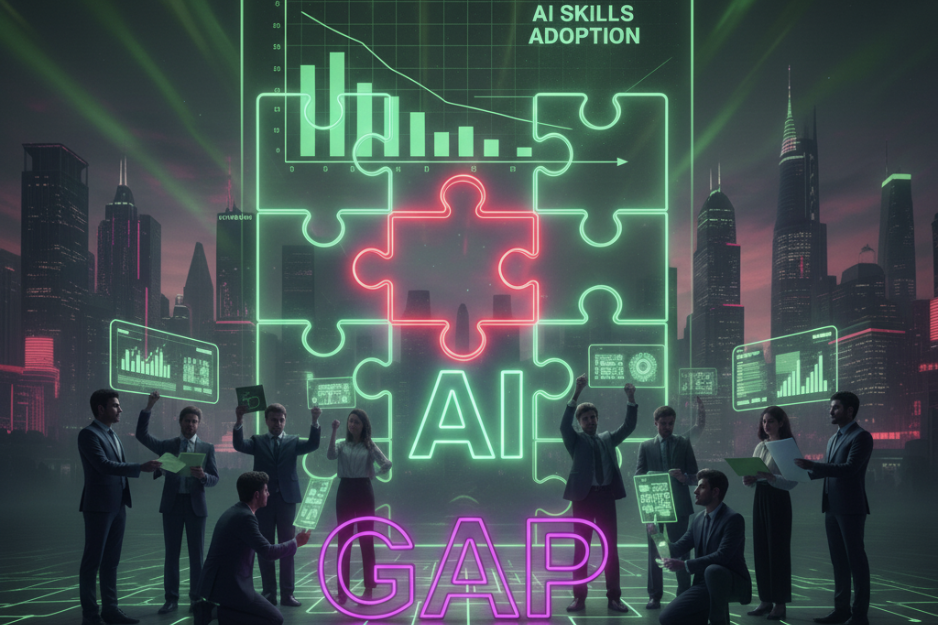
The truth is that despite the hype, interest and noise around AI, our workforce is not ready for large-scale adoption, no matter how much ChatGPT they use. We are at a critical standpoint where companies want to integrate AI but their teams lack the mindset or training to use these tools efficiently. The AI skill gap in Pakistan is one of the biggest deterrents to growth and competition in a rapidly changing market.
The good news is that it is fixable. If Pakistani enterprises put in place the right structures and processes and adequately upskill their workforce, they can build AI-native teams a lot faster than they realize. Contrary to popular belief, this change does not require a ginormous budget or Silicon Valley infrastructure. What you need is culture, clarity, and (most importantly) commitment.
Here is how you can turn your organization into an AI-native competitive industry leader.
Why is Pakistan’s AI Skill Gap Getting Wider
A common misconception is that Pakistan lacks talent. That is not true. After all, more than 500,000 IT professionals are working cross software development, BPO, SaaS and digital services, with 25000 more graduating and joining the workforce annually. We have one of the most dynamic, native-level English speaking professionals on the planet.
No, the skill gap arises because there is a mismatch between the pace of AI progress and the pace at which organizations train their people. Here’s why:
It feels like AI is developing much faster than employees can learn
New tools, new models, new workflows are hitting the market faster than ever. Every few weeks, the landscape shifts. This makes most employees feel like they’re constantly falling behind and can’t keep up with this “New Gen” tech.
I have seen customer support teams work hard to learn a tool, and then six weeks later, a new version arrives with completely different features. Instances like this make people feel frustrated.
AI talent is concentrated in a few sectors
Industries like tech, telecom, and finance have the advantage when it comes to AI. However, sectors like agriculture, retail, healthcare, education, and public organisations lack access to skilled AI practitioners.
This uneven distribution creates a national imbalance.
Misconceptions are impeding adoption
Many employees still see AI as either “too technical,” “not relevant to their role,” or “a threat to their job.” This is especially relevant in the cases of older employees.
This psychological resistance slows down the adoption curve.
The gender disparity is very real
Only 29% of AI roles in Pakistan are filled by women. The number for just technical jobs is even lower at 25.3%. This is not just a gender issue . It is a capacity issue. Pakistan has unintentionally closed opportunities for women which lessens the total available AI talent pool.
Training is expensive, too generic, or inaccessible
In Pakistan, only a meagre 52% have received any official training on using AI safely or effectively. Moreover, a majority of employee training options today:
- focus on coding instead of practical workflows.
- are not role-based which is rarely helpful.
- require too much upfront cost.
- have no connection to the employee’s day-to-day tasks.
As a result, employees cannot move past the AI awareness stage to AI application.
What is the Difference Between an AI-Trained Team and an AI-Native Team?
Most Pakistani enterprises today are focusing solely on “AI training.” However, very few are building “AI-native teams.” A lot of the people I meet don’t even know the difference between them, which is massive.
AI-trained teams
These trainings are usually done by attending workshops or webinars that teach prompting. If they are a little more advanced, they may even teach their employees how to use a few tools. They might even make the attendees try out AI on their own, but that is as far as it goes. Companies often rely on tech-savvy youngsters or tech teams to guide the attendees.
AI-native teams
AI native teams, on the other hand, work entirely differently. They use AI in their daily workflow and are able to operate cross-functionally around AI-driven processes. Imagine a person being able to do multiple stacks, without going back and fro between different departments. They understand when to not use AI because it will be redundant or risk data. They basically have AI literacy, not just tool familiarity, which makes them very efficient, in my opinion. Companies can build around a culture of experimentation, speed, and continuous learning which promotes innovation.
In AI-native teams, AI isn’t a project. It’s a way of working.
You might be thinking, why does this diction matter, AI is just AI. Well, it matters because AI-native teams adopt faster, innovate faster, solve problems faster and generate more value for the organisation.
In a market as competitive as Pakistan’s, speed is everything.
The Biggest Challenges Facing Pakistani Companies Trying to Build AI-Native Teams
Building AI-native teams in Pakistan is not as simple as sending a few employees for certification. Unfortunately, it is a lot more complicated than that. In fact, companies face several challenges that are systemic in nature, such as:
1. Infrastructure Limitations
Pakistan currently has around 2.5 petaflops of compute power. We need at least 8 petaflops for the scale of AI adoption that is necessary in Pakistan. I previously talked about it here.
And yes, this does not stop companies from using AI, but it limits how far they can go. It’s like cutting off one’s own leg.
2. Lack of localized datasets
This is such an important point. Imported datasets drop in accuracy when applied to Pakistani contexts (from 98% to 70% in some cases). Without datasets that take into account Pakistan, AI adoption remains slow and, oftentimes, inaccurate.
3. Cultural resistance
In many workplaces, employees see AI as a threat. The first thing that people saw during the rise of AI was that companies replaced 50–60% of staff after AI adoption. This heightened their fear.
But after leading more than 8000 employees, I’ve learnt that AI works best when employees trust it, not when they fear it.
4. A Lack of leadership understanding
Regrettably, it’s not just the employees that are part of the problem. Even many leaders still see AI as a “technology project,” “IT responsibility,” or something to explore later. This later comes when it’s too late.
In reality, AI is not just a tech stack deployment. It is something that transforms your business entirely.
Thus, without leadership alignment, teams cannot become AI-native.
How can Pakistani Enterprises Can Build AI-Native Teams: AI Skill Gap Solutions Pakistan
As someone who has been at the forefront of technology development for almost 2 decades, here’s my 11-part strategy to transform your workforce into AI-native teams.
1. Start With an AI Readiness & Skills Audit
Remember, blind investment is just a waste of resources. Before investing in training, companies must understand their current state.
A good idea would be to start with an audit. It should include:
- Evaluating employee confidence.
- Looking at high-impact use cases.
- Checking data quality and accessibility.
- Assessing security and compliance readiness.
This will lay down the foundation for all future progress in your organization.
2. Build Ethical & Responsible AI Guidelines
Pakistan has almost no local AI audit capacity. So companies must create internal frameworks.
These should ideally cover data privacy, bias mitigation, transparency, accountability, and the boundaries of permissible AI use.
This builds confidence and reduces risk.
3. Create Role-Based AI Skills Development Plans
You need to understand that not everyone needs to learn everything.
For example:
- Managers learn AI-driven workflow redesign.
- Analysts learn data literacy + prompting.
- Customer service teams learn AI-assisted communication.
- Technical teams learn MLOps, pipelines, version control.
Training should be personalised and tied directly to job responsibilities.
4. Define Clear Levels of AI Proficiency
Companies should create a tiered model where a basic AI user operates tools, a proficient User adapts those tools to workflows and an advanced Specialist should be able to build or govern systems.
This structure will make talent development measurable.
5. Upskill & Reskill Existing Employees
Hiring new AI talent is expensive and, frankly, unrealistic. Your organization’s focus should be on upskilling existing employees. It is faster and cheaper. But, most importantly, existing employees already understand the business, its objectives and its ethics, something external hires may take years to learn.
6. Deploy technology to scale AI training
The best way to train large teams is through technology. You can use:
- LMS platforms for structured courses.
- LXP platforms for personalised learning.
- microlearning for fast adoption.
- AI-powered learning tools for instant feedback.
Learning must become continuous, not one-off.
7. Embed AI Into Daily Workflows
You should not confine AI to pilot projects. Teams must use AI in meeting preparation, research and analysis, customer conversations, reporting, financial modelling, marketing content, recruitment and HR processes, and everything in between.
The more employees use AI, the more native it becomes.
8. Hire Strategically But Only for Critical Gaps
Trust me, you don’t need 20 data scientists. Most companies need:
- one AI governance lead.
- one ML engineer or architect.
- one data product manager.
- 3–5 AI champions.
Every additional capability can be learned internally.
9. Secure Funding for AI Upskilling
While AI transformation does not necessarily require huge budgets, it does require a dedicated budget.
A good option to avail for organizations can be partnering with subsidised learning platforms or getting vendor-supported training.
10. Build Partnerships With Academia and Industry Bodies
Like I said previously, partnerships can actually accelerate upskilling while keeping costs low. Universities can help with certifications, research collaborations, and domain-specific AI programs.
While Industry partners can provide real-world use cases, sandbox environments, and tools and platforms.
11. Continuously Measure and Improve
KPIs are everything when it comes to measuring success. AI maturity must be tracked over time.
Key metrics can include:
- productivity improvements.
- speed of delivery.
- adoption rates.
- accuracy improvements.
- reduction in repetitive work.
- employee satisfaction.
This keeps the AI transformation alive.
How Different Pakistani Industries Can Adopt AI-Native Models
Healthcare
- diagnostic automation,
- administrative streamlining,
- triage,
- AI-enabled clinical workflows.
Manufacturing
- predictive maintenance,
- real-time monitoring,
- inventory optimisation.
Education
- AI tutors,
- personalised learning,
- automated grading.
Finance
- fraud detection,
- credit scoring,
- automated customer service.
Retail
- demand forecasting,
- customer segmentation,
- AI-powered merchandising.
A 90-Day Action Plan for Pakistani Enterprises
Days 1–30: Awareness and Audit
You will need to conduct an AI readiness assessment. In it, you will identify top workflows for AI. Then, train leadership first, not your employees. They need to see role models before they apply it themselves.
Days 31–60: Pilot Phase
This is your time to experiment. Launch 3 high-impact use cases that are important for your organization and then train the teams involved in pilots. You need to build internal AI champions, not just employ external ones.
Days 61–90: Scale and Institutionalise
This is the final and most crucial step. Organizations will create company-wide AI SOPs. They will deploy role-based learning paths and establish an internal AI community. This will help scale without costing too much.
By day 90, a company becomes meaningfully AI-native.
Final Thoughts
Pakistan is at a crossroads. The world is moving forward with AI, and we have a rare chance to do the same. If we miss this opportunity, there will be no other ships waiting at the dock. We do not need to copy others. We need to build our own AI-native culture, our own talent pipelines, and our own way of working. In the end, the AI skill gap in Pakistan is not a technology problem. It is a people problem, and people problems are solvable. With structured learning, thoughtful leadership, and a commitment to continuous improvement, every organisation in Pakistan can build AI-native teams faster than they imagine.